


Your email campaign just hit a 22% open rate. Meanwhile, text messages sit at 98%. That’s not a typo. Customers check their phones 96 times daily. Your marketing messages deserve to be there.
We’ve tested and reviewed nine tools that help you reach customers where they’re already looking, right in their text inbox.
A strong website builder can help small businesses turn SMS campaigns into real traffic, leads, and sales. The platforms in the table below are worth comparing for their ease of use, design flexibility, and business friendly features. The right builder can also make it easier to create landing pages and build trust with new customers. See our recommended website builders here.
Website Builders That Help Small Businesses Convert More
| Provider | User Rating | Recommended For | |
|---|---|---|---|
 | 4.6 | Beginners | Visit Hostinger |
 | 4.4 | Pricing | Visit IONOS |
 | 4.2 | Design | Visit Squarespace |
Top 10 Best SMS Marketing Platforms Reviewed
1. Mailchimp: Best Unified Platform for SMS and Email Marketing
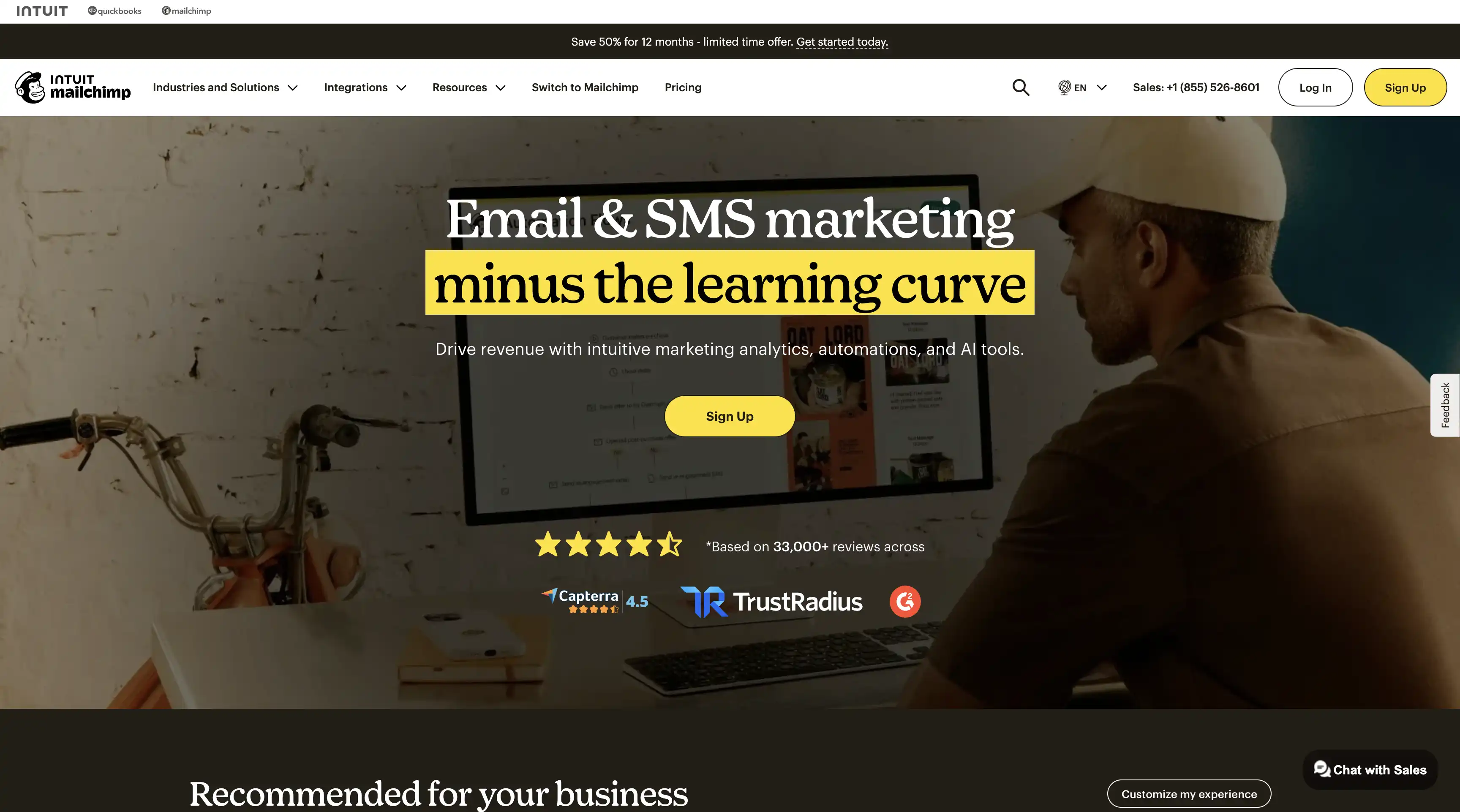
Mailchimp treats SMS as an extension of its email platform rather than a separate product, so both channels are managed from one dashboard instead of two disconnected tools.
Because SMS shares Mailchimp’s contact data and automation builder, a segment or trigger built for email works the same way for text. For businesses that want email and SMS working together rather than managed separately, that shared foundation is the main draw.
Best For: Businesses that want to run email and SMS from a single platform rather than stitching two tools together.
Pricing: SMS is an add-on priced at $20 per month on top of a paid email plan, with no charge until the SMS application is approved.
Ratings: 4.4 on G2 and 4.5 on Capterra.
Key Features:
Contact data flows between channels automatically. Email and SMS pull from the same audience list, so a segment built for a campaign works the same way whether it goes out by text or inbox.
Automation flows cover both channels from one builder. Someone abandons a cart? A text can follow the same trigger logic as the email version. Someone joins the list? A welcome series can run across email and SMS without setting up two separate systems.
MMS support opens up richer messaging for Standard and Premium users. Product images, GIFs, and visual promotions can go out to contacts in the US and Canada, not just plain text. Consent management is built in too, so opt-ins and compliance stay handled as texting gets added to the mix.
Pros: Running email and SMS from a single platform keeps reporting and audience data in one place, and the shared automation builder means existing email logic doesn’t need to be rebuilt for text.
Cons: SMS runs as a separate line item with its own approval process before sending, and MMS is restricted to Standard and Premium plans reaching US and Canada contacts only.
2. Salesmsg: The Best SMS Marketing Software for Sales Teams

Salesmsg earns its place as the top choice for sales-focused organizations needing deep CRM connections. This platform understands that salespeople need speed and context, not complexity.
Best For: Sales, marketing, and support teams requiring robust CRM integration.
Pricing: Starts at $25/month for 500 credits.
Ratings: G2: 4.6/5 | Capterra: 4.6/5.
Key Features:
The two-way SMS and MMS capabilities shine through a shared inbox that keeps conversations organized. Multiple team members can manage responses without stepping on each other’s toes. Team collaboration becomes seamless rather than chaotic.
AI Agents represent the platform’s standout feature. These automation tools qualify leads and book meetings automatically. While you sleep, Salesmsg works.
Built-in calling with Voice Intelligence provides transcripts and actionable insights from every conversation. Native sync with HubSpot, Salesforce, ActiveCampaign, and Pipedrive means your existing setup stays intact.
Pros: The all-in-one approach combining SMS, calling, and CRM management excels for pipeline management. Sales teams get everything in one place.
Cons: High-volume e-commerce blasts aren’t its strength. If you’re sending tens of thousands of promotional texts daily, look elsewhere.
3. SimpleTexting: The Top Choice for Small Business Flexibility

SimpleTexting lives up to its name. The platform strips away complexity while maintaining powerful capabilities for growing businesses.
Best For: General small businesses, franchises, and real estate professionals.
Pricing: Starts at $29/month for 500 credits.
Ratings: G2: 4.7/5 | Capterra: 4.7/5.
Key Features:
Unlimited keywords let you create as many “Text-to-Join” campaigns as needed. SALE, INFO, DEALS, SIGNUP. No extra charges for creativity.
Rollover credits represent genuine value. Unused credits carry over to the next month. Slow month? Your investment isn’t wasted. This feature alone sets SimpleTexting apart from competitors.
The mass texting dashboard makes creating SMS marketing campaigns straightforward. The mobile app lets you manage everything on the go. Customer experience stays consistent whether you’re at your desk or in the field.
Pros: The intuitive interface means minimal learning curve. Seven-day support provides help when needed. The platform scales beautifully as your list grows.
Cons: SimpleTexting focuses primarily on SMS, so omnichannel marketing messages require integrations with other platforms.
4. SlickText: Highest Rated Text Marketing Platform for Automation

User satisfaction scores tell a story. SlickText consistently earns the highest ratings among SMS marketing tools, and the reasons become clear quickly.
Best For: Businesses building loyalty programs and automation sequences.
Pricing: Starts at $29/month for 500 credits.
Ratings: G2: 4.8/5 | Capterra: 4.8/5.
Key Features:
Text-to-Win contests drive engagement naturally. People love winning things. SlickText makes running giveaways simple with built-in tools for loyalty rewards. Customer retention improves when people feel appreciated.
Workflows handle automated replies and behavioral triggers. Someone opts in? They get a welcome message. Someone makes a purchase? They receive a thank you. No manual intervention required.
International capabilities support messaging to over 200 countries. Growing globally? SlickText grows with you.
Pros: The platform is extremely user-friendly. Even team members without technical knowledge can create campaigns within minutes. Those satisfaction ratings reflect genuine ease of use.
Cons: Advanced automation often requires Zapier connections. Built-in automation handles common scenarios well, but complex sequences may need additional tools.
5. EZ Texting: Best for Beginners to Send SMS Messages

Starting from scratch feels intimidating. EZ Texting removes that friction entirely. The platform prioritizes speed to first campaign above all else.
Best For: Users with limited technical experience who value quick setup.
Pricing: $20-$25/month for 200-500 credits.
Ratings: G2: 4.5/5 | Capterra: 4.3/5.
Key Features:
The Shutterstock integration opens access to millions of stock photos for MMS messages. Professional imagery without professional photography costs. Visually appealing marketing campaigns become accessible to everyone.
QR codes generate automatically for easy list building. Print them on receipts, business cards, or signage. Potential customers scan and join instantly. This feature transforms every touchpoint into a subscriber acquisition opportunity.
Built-in design tools include an image editor that helps non-designers create polished messages. No Photoshop required.
Pros: EZ Texting offers the fastest setup time in the industry. If you need to send bulk messages today, this platform delivers.
Cons: Advanced features and extra keywords can increase costs. The base price is attractive, but add-ons accumulate.
6. Textedly: Budget-Friendly SMS Marketing Services

Budget constraints shouldn’t eliminate SMS from your marketing strategy. Textedly proves that affordable options can still deliver substantial value.
Best For: High-volume senders, nonprofits, and schools managing tight budgets.
Pricing: Starts at $24/month for 1,000 credits.
Ratings: G2: 4.6/5 | Capterra: 4.5/5.
Key Features:
The credit structure represents genuine value. One thousand credits for $24 means significantly lower cost per message than most competitors. High-volume texting becomes financially viable.
Text-to-Pay enables secure payment requests via SMS. Send an invoice link. Customers pay immediately. Cash flow improves.
Voice services extend beyond text with broadcasting features. Reach customers through multiple channels without multiple subscriptions.
Pros: Textedly delivers one of the lowest costs per text message available. The simple interface keeps things accessible.
Cons: No dedicated mobile app limits on-the-go management. Advanced automation features remain limited compared to pricier alternatives.
7. Salesmate: Best CRM with Integrated SMS Messages

Why pay for two systems when one does both? Salesmate combines customer relationship management with SMS capabilities in a single subscription.
Best For: Businesses wanting unified CRM and text messaging.
Pricing: Integrated into CRM subscription tiers.
Ratings: G2: 4.6/5.
Key Features:
The built-in CRM lets you manage contacts, deals, and pipelines alongside text conversations. Context lives where you need it. When responding to a message, customer history sits right there.
A Power Dialer handles integrated calling. Email, SMS, and phone calls flow from one platform.
Sequences enable multi-channel drip campaigns combining email and SMS. Orchestrate complete customer journeys without juggling tools. Marketing automation software works best when everything connects.
Pros: Eliminating separate subscriptions saves money and reduces complexity. Centralized data means better decision-making.
Cons: Users wanting simple texting may find Salesmate feature-heavy. Sometimes less is more.

Namecheap
8. TextMagic: Best Pay-As-You-Go Text Marketing

Monthly subscriptions don’t work for everyone. Seasonal businesses, event organizers, and companies with irregular sending patterns need flexibility.
Best For: Businesses with unpredictable sending volumes or global messaging needs.
Pricing: $0.04 per text with no monthly fixed fee.
Ratings: G2: 4.4/5 | Capterra: 4.5/5.
Key Features:
Global reach extends to 200+ countries. International businesses appreciate consistent delivery worldwide. Dedicated virtual numbers establish local presence in target markets.
Email-to-SMS enables sending texts directly from your email client. No dashboard login required. Compose in Gmail, reach phone numbers instantly.
Robust API access supports custom integrations for technical teams. Build exactly what you need.
Pros: Zero monthly commitment means paying only for actual usage. Perfect for testing SMS marketing strategy without long-term risk.
Cons: High-volume senders will find per-message costs exceed subscription alternatives. The pay-as-you-go model favors light users.
9. Omnisend: Best for E-commerce Marketing Campaigns

Online stores operate differently. Cart abandonment, purchase history, shopping behavior. These data points demand specialized tools. Omnisend delivers exactly that.
Best For: Online stores using Shopify or BigCommerce needing omnichannel capabilities.
Pricing: Custom pricing based on list size and channel mix.
Ratings: G2: 4.6/5.
Key Features:
The omnichannel approach combines SMS, email, and push notifications in unified workflows. One automation can trigger messages across multiple channels based on customer actions. E-commerce marketing demands this integration.
Pre-built cart recovery automations recover lost sales automatically. Someone abandons their cart? A personalized text reminds them. Revenue recaptures itself.
Advanced segmentation targets customers based on shopping behavior. First-time buyers receive different messages than repeat customers. Personalized text messages drive more sales than generic blasts.
Pros: Omnisend specializes in e-commerce revenue generation. Strong reporting shows exactly what’s working.
Cons: Businesses without e-commerce needs may find the platform overbuilt and overpriced for their requirements.
10. Sakari: Best for International Personalized Messages

Global businesses face unique challenges. Carrier relationships vary by country. Compliance requirements differ across borders. Sakari handles these complexities gracefully.
Best For: Global businesses requiring CRM integrations and international delivery.
Pricing: Starts at $25/month for 500 segments.
Ratings: G2: 4.5/5 | Capterra: 4.5/5.
Key Features:
Robust delivery to 200+ countries ensures messages arrive reliably worldwide. International messaging requires carrier relationships Sakari has built.
Rich messaging supports multimedia and personalized tokens. Make every text feel individual even when sending to thousands.
Deep HubSpot integration enables two-way sync with workflows. Data moves seamlessly between systems. Actions in one platform trigger responses in the other.
Pros: Excellent international delivery rates combined with cloud-based simplicity. Global reach without global headaches.
Cons: International per-message costs vary significantly by destination. Budget carefully for diverse geographic campaigns.
Comparison of the Best SMS Marketing Platforms
| Software | Best For | Starting Price | G2 Rating | Key Integration |
|---|---|---|---|---|
| Salesmsg | Sales/CRM | $25/mo (500 credits) | 4.6/5 | HubSpot/Salesforce |
| SimpleTexting | Small Biz Flexibility | $29/mo (500 credits) | 4.7/5 | Zapier/Mailchimp |
| SlickText | Automation/Loyalty | $29/mo (500 credits) | 4.8/5 | Zapier/Shopify |
| EZ Texting | Beginners | $20-$25/mo | 4.5/5 | HubSpot/Constant Contact |
| Textedly | Budget/High Volume | $24/mo (1,000 credits) | 4.6/5 | Zapier/HubSpot |
| Salesmate | Integrated CRM | Subscription Based | 4.6/5 | Native CRM |
| TextMagic | Pay-As-You-Go | $0.04/msg | 4.4/5 | Zapier/Slack |
| Omnisend | E-commerce | Custom | 4.6/5 | Shopify/BigCommerce |
| Sakari | International | $25/mo (500 credits) | 4.5/5 | HubSpot/ActiveCampaign |
Why SMS Marketing Software is Essential
The Power of Text Message Marketing and High Open Rates

Here’s a number that should stop you cold. SMS open rates average 98%. Compare that to email marketing hovering around 28%. The gap is staggering.
But it gets more interesting. About 54% of consumers want to receive promotional texts from businesses. Yet only 11% of companies actually send them. That’s a massive opportunity sitting untouched.
Why does text message marketing work so well? Speed matters. Most text messages get read within three minutes of arrival. Think about your own behavior. When your phone buzzes, you check it. We all do.
The revenue impact backs this up. Roughly 96% of marketers report that SMS drives measurable revenue benefits. This isn’t about vanity metrics. It’s about money in the bank.
Consider time-sensitive offers. Flash sales. Appointment reminders. Limited inventory alerts. These messages need immediate attention. Email can’t guarantee that. SMS messages can.
Moving Beyond Basic Texts to Marketing Campaigns
Gone are the days when business texting meant sending the same message to everyone and hoping for the best. Modern SMS marketing platforms have evolved dramatically.
Two-way messaging changes everything. Instead of shouting into the void, you can have actual conversations. Customers reply. You respond. Relationships form. This capability transforms promotional blasts into one on one conversations that build trust.
Advanced tools now offer automated workflows similar to email marketing but with significantly higher engagement. Set up a welcome sequence. Create abandoned cart reminders. Build drip campaigns that nurture leads over time.
Integration capabilities have expanded too. Your SMS app connects directly with CRMs like HubSpot and Salesforce. Customer data flows seamlessly between systems. This enables data-driven targeting that feels personal, not creepy.
The shift from basic bulk messaging to sophisticated SMS campaigns represents a fundamental change in how small businesses connect with customers. Marketing automation software makes this possible without requiring a technical background.

How to Collect Phone Numbers Using Website Popups
Building Your Subscriber List

Before launching any SMS campaigns, you need subscribers. This seems obvious. Yet many businesses skip straight to software selection without addressing list building. A powerful marketing platform means nothing without phone numbers to message.
Website popups remain the most effective capture method. Visitors already expressed interest by arriving at your site. Converting that interest into permission requires strategic thinking.
Incentives matter enormously. What’s in it for them? A discount code works beautifully for e-commerce. Exclusive content appeals to information seekers. Early access to sales motivates bargain hunters. Understanding what is a lead magnet helps you craft compelling offers.
Timing your popup impacts conversion rates significantly. Immediate popups annoy visitors. Exit-intent popups catch people leaving. Scroll-triggered popups engage readers demonstrating interest. Test different approaches to find what works for your audience.
Compliance starts at collection. Clearly explain what subscribers will receive. Obtain explicit consent. Document everything. TCPA violations carry penalties between $500 and $1,500 per message. Proper list building protects your business.
Setting Up a Professional Website
Your SMS marketing drives traffic somewhere. Usually your website. If that destination disappoints visitors, your texting efforts fail despite perfect execution.
Think about it this way. You craft the perfect promotional text. Customer clicks through excitedly. They land on a slow, confusing website. They leave. That’s not an SMS problem. That’s an infrastructure problem.
A slow or unprofessional website kills conversions regardless of how customers arrive. Mobile responsiveness matters especially for text-driven traffic. These visitors are already on their phones. Your site must perform perfectly on mobile devices.
If you don’t have a website or your current one struggles with speed, reliable hosting solves the problem. Your traffic from SMS campaigns deserves infrastructure that converts visitors into customers.
Recommendation: Check out this guide on web hosting to find secure and fast hosting solutions. Your digital storefront needs a solid foundation.
Landing pages dedicated to SMS offers often outperform generic homepages. Create specific destinations for specific campaigns. Track performance separately. Optimize based on data.
Key Features to Look for in Text Marketing Platforms
Automation and Drip Campaigns

Manual texting doesn’t scale. Sending individual messages works fine for ten customers. One thousand? Ten thousand? Impossible without automation.
Look for “set it and forget it” capabilities. A new subscriber joins? Welcome text sends automatically. Someone makes a purchase? Thank you message follows immediately. Anniversary approaching? Celebratory offer deploys without intervention.
Automated drip campaigns nurture relationships over time. Day one brings a welcome. Day three shares a tip. Day seven offers a discount. Day fourteen asks for feedback. This sequence runs continuously for every new subscriber.
These automation features distinguish basic text marketing platforms from sophisticated solutions. The time savings compound dramatically as your list grows.
Behavioral triggers add another layer. Abandoned cart? Triggered message. Website visit without purchase? Triggered message. Long period of inactivity? Triggered message. Responses match actions automatically.
Two-Way Messaging Capabilities
Broadcasting works for announcements. Real relationships require conversation. Two-way messaging transforms your marketing software from megaphone to telephone.
Customers reply to your bulk texts. Questions arrive. Concerns surface. Interest expresses itself. Without two-way capabilities, these responses vanish into the void. With them, opportunities multiply.
Sales teams particularly benefit. A promotional message generates interest. The customer replies asking for details. A salesperson responds from the shared inbox. Conversation happens. Deals close.
Customer support improves too. Receive messages about problems. Respond with solutions. Resolve issues before they escalate to public complaints. Stronger customer relationships emerge from accessible communication.
Most top SMS marketing platforms include two-way messaging. Verify this feature before committing. One-way limitations feel increasingly archaic.
Compliance and Security Tools

TCPA compliance isn’t optional. Violations cost $500 to $1,500 per message sent. Send 1,000 non-compliant texts? That’s potentially $1.5 million in fines. No business survives that.
10DLC registration requirements add complexity. Carriers now require campaign registration before allowing bulk messaging. Your software should handle this automatically, guiding you through registration and maintaining compliance.
Opt-out management must function perfectly. When someone texts STOP, they must immediately stop receiving messages. Manual processes fail. Automated systems prevent violations.
GDPR matters for international customers. European data privacy laws carry their own penalties. Ensure your platform respects these requirements if you message across borders.
Look for platforms that make compliance invisible. The best SMS marketing services handle regulatory requirements without requiring your constant attention. You focus on marketing. They focus on legal protection.
Best Practices for Sending the Right Message
Crafting Personalized Messages
“Dear Valued Customer” doesn’t cut it anymore. Generic blasts get ignored or worse, trigger unsubscribes. Personalized marketing dramatically outperforms mass approaches.
Merge tags insert subscriber names automatically. “Hey Sarah, we have something special for you” beats “Hey there, we have something special for you” every time. That small personalization signals genuine attention.
Segmentation enables relevance at scale. Group customers by purchase history. Separate by location. Divide by engagement level. Then send different messages to different groups based on what matters to them.
Advanced segmentation pushes further. Past purchasers of running shoes might appreciate sock recommendations. Customers who browsed winter coats receive weather-appropriate offers. Personalized texts based on actual behavior feel helpful rather than intrusive.
The stats support this approach. Conversion tracking shows personalized content significantly improves engagement while reducing opt-out rates. Relevance respects attention.
Timing and Frequency

When you send matters nearly as much as what you send. Poor timing wastes great content.
Business hours generally work best. 9 AM to 6 PM catches people during active periods. Texts arriving at 2 AM feel invasive regardless of content. SMS alerts at midnight don’t build positive associations.
Frequency requires balance. Too few messages and customers forget you exist. Too many and they unsubscribe. Most small businesses find one to four messages monthly hits the sweet spot.
Test and adjust based on your audience. B2B customers may tolerate less frequency than B2C. Promotional businesses might sustain higher volume than service providers. Let engagement data guide decisions.
Time zones matter for national campaigns. A 9 AM message in New York arrives at 6 AM in Los Angeles. Schedule by recipient location when possible.
Delivering Value with Every Text
Every message needs a clear purpose. What should the recipient do? What benefit do they receive? If you can’t answer both questions, don’t send the message.
Appointment reminders deliver value through convenience. Flash sale announcements offer financial benefit. Exclusive content provides information recipients can’t get elsewhere. Each text earns its place.
Fluff messages destroy lists. “Just checking in” without substance wastes attention. Customers notice. They unsubscribe. Your list shrinks. Revenue follows.
Think like your customer. Would you want to receive this text? Would it interrupt your day positively? If not, revise until it does.
The right message at the right time to the right person. That formula drives SMS marketing success. Missing any element undermines the others.
Reaching Customers Directly Through Mobile Messaging

Mobile messaging continues evolving beyond simple text. Rich media expands possibilities. Images, GIFs, videos, and links transform plain SMS into engaging experiences.
MMS messages cost more but perform better for visual products. Fashion, food, home decor. These categories benefit from showing rather than telling. Balance cost against impact.
Link shortening tracks clicks while conserving character counts. Most platforms include this automatically. Watch your conversion tracking to understand which messages drive action.
Unlimited contacts and unlimited users matter as you grow. Some platforms charge per team member. Others limit list sizes at lower tiers. Project your growth and choose accordingly.
Create campaigns that feel conversational despite reaching thousands. The blank canvas of a new message holds unlimited potential. Voice consistency helps. Your brand personality should shine through every text regardless of sender.
Text surveys gather feedback efficiently. Simple questions with numeric responses quantify sentiment. “Rate your experience 1-5” generates data without requiring essay responses. Actionable insights emerge from aggregate patterns.
Building Your SMS Strategy
A coherent SMS strategy prevents random acts of marketing. Document your approach before launching campaigns.
Define your goals clearly. More sales? Better retention? Increased engagement? Different objectives demand different tactics. Trying everything simultaneously accomplishes nothing.
Map your customer journey. Where does SMS fit? Top of funnel awareness? Mid-funnel nurturing? Bottom of funnel conversion? Post-purchase retention? Different stages require different messages.
Establish metrics that matter. Open rates indicate delivery but not impact. Click rates show interest. Conversion tracking reveals revenue. Focus on numbers tied to business outcomes.
Integrate with other platforms for comprehensive views. Your text marketing tools should connect with email systems, CRM databases, and analytics platforms. Siloed data limits understanding.
Plan for scale. What works at 500 subscribers may break at 5,000. Choose tools and processes that grow with your business.

Conclusion
The best SMS marketing software depends entirely on your specific needs. Sales-focused teams thrive with Salesmsg. Budget-conscious organizations appreciate Textedly. E-commerce businesses need Omnisend’s specialized features. International companies require Sakari’s global reach.
Every platform reviewed offers genuine value for the right user. Match capabilities to requirements. Start with the comparison table above and narrow based on your priorities. Remember that 98% open rate waiting for your first campaign.
Next Steps: What Now?
- Audit your current customer communication channels and identify where SMS fills gaps.
- Select two or three platforms from this list matching your budget and requirements.
- Sign up for free trials to test interface usability and feature sets.
- Build your initial subscriber list using website popups and opt-in incentives.
- Create your first campaign with a clear offer and strong call to action.
- Measure results and optimize based on engagement data.


