


Are you struggling to understand what keyword difficulty is in SEO, and why it matters? It is a fundamental SEO metric that measures search engine optimization performance.
In this guide, we’ll give you practical information about what keyword difficulty is. You’ll learn how to calculate keyword difficulty and why it’s crucial for your SEO strategy.
Understanding keyword difficulty is essential, but your SEO strategy is only as strong as the website you build on. The right website builder gives you clean structure, fast performance, and built-in optimization tools that support better rankings. Explore our recommended website builders to create a site designed for SEO success.
Build an SEO-Friendly Website with the Best Website Builders
| Provider | User Rating | Recommended For | |
|---|---|---|---|
 | 4.6 | Beginners | Visit Hostinger |
 | 4.4 | Pricing | Visit IONOS |
 | 4.2 | Design | Visit Squarespace |
What Is Keyword Difficulty in SEO? The Core Concept
Keyword difficulty (KD) is a comparative score that shows how competitive a search query is and how tough it will be to land in the top organic search results. It is not a Google ranking factor. It’s a modeled score created by third-party platforms to help you prioritize opportunities at scale.
In most keyword research tools, you’ll see a KD value next to search volume so you can judge traffic potential and effort side by side. A keyword is simply the term people type into a search bar.
Since KD is a practical SEO metric, you can use it to organize ideas and plan pages. It helps you avoid overspending on topics where you have little chance to compete right now.
How a Keyword Difficulty Score Is Presented

SEO tools like Ubersuggest, Ahrefs, SEMrush, and Moz present keyword difficulty as a numerical score. At first glance, you can tell the level of keyword competition and decide where to invest:
- Scale: Most platforms use a scale method ranging between 0 and 100. 0 means the competition is low. 100 suggests the keyword is extremely difficult to rank.
- Labels: Besides the number scale, you can see categories like Easy, Possible, Moderate, or Hard.
- Color Coding: Some tools may add colors for clarity. Green means easy, yellow for medium, and red means hard.
- Comparisons: Some sites also display some metrics like backlinks and domain authority of ranking sites. That helps to explain why a keyword has that specific score.

Why Keyword Difficulty Is a Cornerstone of SEO Strategy

Keyword difficulty is the foundation of your SEO strategy. Here’s why:
- Resource management: It prevents wasted work by steering you away from terms with extreme ranking difficulty that demand heavy budgets, time, and links.
- Strategic decision-making: KD feeds your broader keyword strategy. It sets realistic expectations and guides which topics make sense now, later, or never.
- Content prioritization: KD helps you pick the right queries for your calendar so you publish pages that can realistically rank and deliver results.
- Expectation management: Clear KD numbers help you explain to stakeholders why some goals require patience and sustained SEO efforts.
- Scale: You can use keyword difficulty across thousands of ideas to sort, group, and choose quickly without manual research on every single topic.
Bottom line? You use keyword difficulty to inform your content strategy, not to replace judgment.
How Is Keyword Difficulty Calculated by SEO Tools?

There’s no universal formula for calculating keyword difficulty. Every platform uses its own dataset and weighting.
Most models rely heavily on links pointing to the top-ranking pages for the term. That’s because backlinks remain among the most reliable ranking factors. Typically, a higher number of strong links across the top 10 means a higher difficulty score.
To keep your data consistent, pick one SEO tool for a project and stick with it. Mixing tools blurs your benchmark and makes it harder to compare month over month.
If you want background on major platforms, here’s an overview of Ahrefs and a primer on SEMrush.
Under the hood, the keyword difficulty metric often considers:
- Referring domains to the current top results.
- The number of referring domains per page.
- Overall, backlink profiles and quality backlinks of ranking pages.
- Domain-level authority signals, such as domain authority or domain rating.
- On-page match with the query and other factors that reflect how the page satisfies intent.

Namecheap
Understanding Different Tool Methodologies
Different tools use different methods to assign keyword difficulty. Here are some popular ones:
Ahrefs
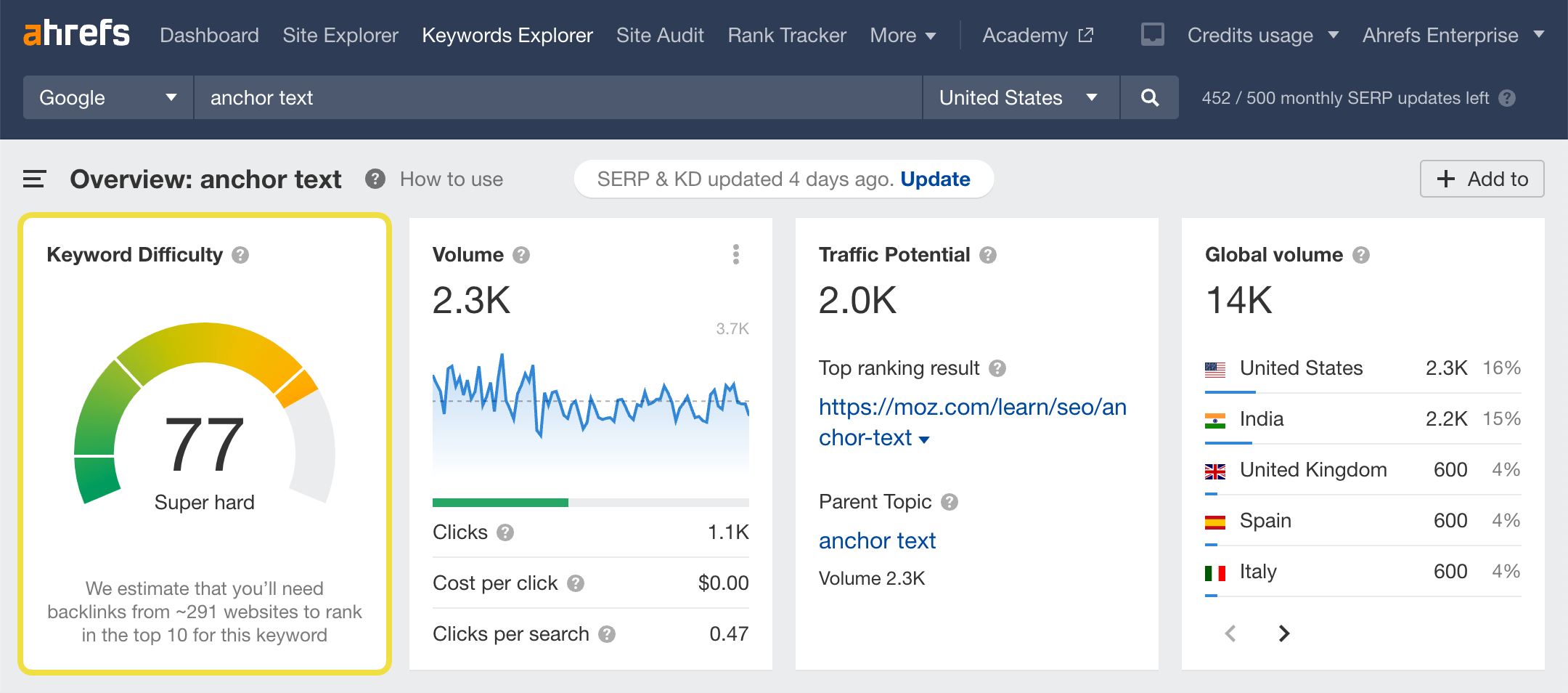
For Ahrefs, KD is driven almost entirely by the number of unique websites linking to each of the top 10 results. That makes it very sensitive to referring domains.
SEMrush
SEMrush blends multiple signals. Signals like average referring domains, the share of followed links, and the average authority of ranking domains. See how it defines authority.
Moz
Moz uses Page Authority (PA) and Domain Authority (DA) of the top results and adjusts by a projected click-through rate. If you need a refresher on DA, here’s a clear explanation of domain authority.

Sistrix
Sistrix reports a logarithmic score using around 15 values. A 10-point jump roughly doubles the competition.
Why Keyword Difficulty Calculated by Tools Can Differ
Here’s an example of a health term that shows variance for a particular keyword:
| Tool | Keyword Difficulty Score |
| Ahrefs | 83 (Very Hard) |
| Semrush | 100 (Very Hard) |
| Moz | 72 |
Those gaps exist because each platform weighs backlink profile strength, the number of referring domains, and SERP features differently. Always compare within one platform for a given keyword, then validate by looking at the live search results.
7 Key Factors Influencing a Keyword’s Difficulty Score
Below are some of the top factors influencing a keyword’s difficulty score:
1. Backlinks and Referring Domains

Backlinks act like votes. The more trustworthy sites vouch for a page, the harder it becomes to dislodge it. When many top-ranking pages have deep link equity and robust backlink profiles, expect higher difficulty.
2. The Domain Authority of Competing Sites
If the front page is full of high-authority brands, the bar rises. Strong domains tend to earn links faster and maintain visibility. Understanding domain authority reveals why authoritative websites dominate contested queries.

3. Search Intent Alignment
You won’t win if you miss the why behind a query. Study the SERP and match the format: guide vs. tool vs. product vs. comparison. Nailing the search intent helps you reduce practical SEO difficulty even when links are similar.
4. Content Quality and E-A-T

Google seeks trustworthy, accurate, and helpful content, especially for sensitive topics like health or finance. Learn how E-A-T shapes the bar for quality and topical authority. Expert input, citations, and clear sourcing help you establish authority and compete.
5. Keyword Search Volume
Queries with high search volumes attract more competitors and links. That tends to push KD up. Conversely, lower search volumes can signal less crowded spaces with lower difficulty scores yet still deliver steady wins.
6. SERP Features
Features like Featured Snippets, Top Stories, video carousels, and People Also Ask can depress clicks. When the SERP steals attention, the effective difficulty rises because you need to claim a rich result to get traffic. Track which SERP features appear before you commit.
7. Long-Tail Keywords

Long-tail keywords are precise and often less competitive. They carry a clearer intent and can convert well. Stack enough low-difficulty wins, and you build momentum for bigger topics.
What Is a Good Keyword Difficulty Score?
A good keyword difficulty score is the KD range that your site can consistently win based on its current strength, links, and content depth. For new sites, aim low at first. As your pages gain links and trust, you can target mid-range terms and scale up.
- Low (e.g., <30): Quick-win territory. Pages ranking here often have few links.
- Moderate (e.g., 30–70): Balanced opportunities for many teams.
- High (e.g., >70): Crowded spaces with entrenched brands and high competition.
Remember, good keyword difficulty depends on your baseline. Audit what you already rank for and set your next targets slightly above that level.
How to Check Keyword Difficulty and Find the Best Keywords
Follow these four steps to check difficulty and find the best keywords:
Step 1: Brainstorm and Analyze Your Seed Keywords

Start with a seed keyword in one platform. Generate a large list, then sort by search volume and KD.
Use color scales to spot clusters where demand is healthy but KD isn’t extreme. For process tips, read this guide to keyword research. Within minutes, you’ll uncover keyword ideas you can pursue now.
If you prefer to expand with multiple data sources, export lists from your favorite keyword research tool and normalize columns so you can compare apples to apples.
Step 2: Refine Your List Based on Search Intent
Open the SERP for each candidate. Ask: Can I produce something better than the top-ranking pages? Does my page type match intent?

If the page type mismatch is large, note the keyword characteristics and park it for later. If intent fits, shortlist those terms as relevant keywords and move on.

At this stage, check keyword difficulty, but also scan who ranks. Are they high-authority sites? Are they niche blogs? If the front page is filled with authoritative websites, you might need more links, deeper content, or a smarter angle to compete.
Step 3: Don’t Automatically Avoid High-Difficulty Keywords
If a term maps to your product or core service, pursue it—even if it carries a high difficulty score. Just plan the road.
You’ll need stellar content, a trustworthy backlink profile, and consistent promotion. High-difficulty terms reward patience. As you grow topical authority, you’ll earn links and mentions that make it easier to rank for adjacent ideas.
To accelerate, invest in a structured outreach program. Develop a good link-building strategy to help you gather the quality backlinks needed to move.

Step 4: Turn Your Keyword Research into a Website

Creating content after drafting and refining your keyword list is the next crucial step. For this, you’ll need to create a platform for your content. A website serves as the fundamental tool for establishing your online presence and building authority.
The website functions as your main content center, which enables you to connect with your target audience. The easiest way to get started is with the best website builders. These platforms are designed for beginners and don’t require any coding knowledge.
The most widely used platforms on the market currently are Hostinger and IONOS. Hostinger provides an easy-to-use interface, while IONOS offers professional templates for users.
If you have advanced technical skills, you can create a self-hosted WordPress website. Choose the best web hosting providers to gain complete control over your platform.
Keyword Difficulty vs. Keyword Competition: What’s the Difference?
Keyword Difficulty is an organic-only guide. It’s a metric that measures how hard it is to rank on SERPs. It’s based on the current search engine results and the strength of the ranking pages.
Conversely, Keyword Competition is a paid ads metric in Google Ads that shows how many advertisers bid on a term. See the levels in Google Ads.

Best Practices for Using Keyword Difficulty Metrics
Below are some tips for effectively using KD metrics:
- Use KD as a guide, not a rule. Because KD is modeled, always validate assumptions by opening the SERP.
- Prioritize relevance. Targeting off-topic terms can run afoul of Google’s helpful content policy.
- Benchmark against yourself. Check the KD of terms where you already appear and stretch from there.
- Audit link demand. Estimate how many links you need to compete with the top-ranking pages in your niche.
- Track search intent and page type. If the SERP is all guides, publish a guide. If it’s product pages, lead with a product page.
- Iterate. As you grow, revisit saved terms and expand into tougher spaces.

Conclusion
SEO keyword difficulty isn’t about avoiding the high difficulty keywords entirely. It’s about balancing your use of higher-difficulty keywords with those having lower difficulty scores. It’s about targeting low-to-medium difficulty keywords and establishing authority with high-competition ones.
This keyword strategy helps you prioritize relevant keywords that match your topical authority. That makes your website top ranking on search result pages and makes your platform an authoritative website.
Don’t forget to invest in other content strategies for the best results.

Next Steps: What Now?
You can do the following to elevate your SEO efforts:
- Explore keyword research tools like SEMrush, Moz, and Ahrefs to find the best keywords.
- Build a keyword list that features keywords with low, medium, and high difficulty scores.
- Align keyword difficulty with user search intent.
- Create content that’s optimized with your keyword list.
- Start with keywords with low difficulty scores and gradually work towards those with high difficulty.
- Evaluate other top-ranking pages for your target keyword and check their strengths.
- Monitor and track your progress regularly.
- Combine your strategy with other SEO metrics like search intent, organic search results, search volume, etc.
- Test different keywords, measure performance, and refine your approach.
Further Reading & Useful Resources
Here are more resources that you’ll find useful for your SEO strategy:
- SEO basics: How to optimize your website for better rankings.
- 25 best AI SEO tools: Automate your SEO & save time (2025).
- How to make money with SEO: 12 proven ways (+ examples).
- How to boost the SEO of your website using these 10 simple-to-follow methods.
- Mastering SEO strategies: techniques to outshine competitors.


